Home > Blog > Why Fertilizer Traders Invest in Liquid Production
Why Fertilizer Traders Invest in Liquid Production
Date 2026.09.04
Share
For a fertilizer trader, owning production is not a badge of ambition; it is a way to protect a market that has become predictable enough to deserve more control. A liquid project can make that move feel attainable because it can be built around mixing, storage, and filling instead of a full dry-granulation route. The real question is whether the trader has a narrow, repeatable opportunity worth making in-house.
The investment case begins with repeatable demand
Repeat orders are the strongest reason to explore liquid fertilizers custom manufacturing. A trader who keeps receiving the same requests for a manageable set of liquid grades, pack sizes, and delivery windows is already holding the outline of a first production range. Bringing that work in-house can improve responsiveness and product ownership, but only if the demand pattern is more reliable than a handful of opportunistic orders.
The useful test is simple: can the team name the first products, the customers who reorder them, and the conditions those customers expect after delivery? When the answer is clear, production planning becomes a commercial extension of the existing business. When it is vague, machinery can turn uncertainty into fixed overhead rather than a competitive advantage.
The early demand signals
A disciplined launch range gives a new producer room to learn without chasing every possible formula. It should be supported by sales evidence that is specific enough to guide the tank, filling format, and quality checks.
*The same liquid grades are requested across more than one selling season.
*Customers accept a limited set of container sizes and labeling requirements.
*The business can source the relevant raw materials and keep a clear record of each batch.
Why liquid production can fit a trading business
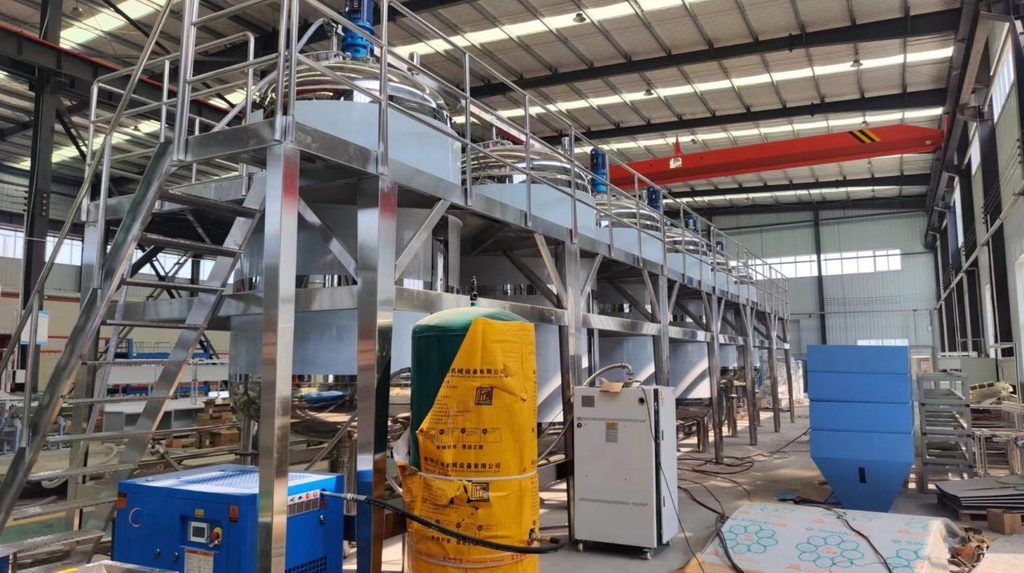
Liquid production can offer a gentler first manufacturing step because it does not need evaporation, drying, or granulation as part of the core route. A liquid fertilizer production line can therefore focus on preparation, mixing or reaction, filtration where the formula requires it, storage, pumping, and filling. That shorter process still demands control, but it gives a trading team a more direct link between its sales plan and the finished container.
The commercial benefit is flexibility with discipline. A trader can validate a small range, refine packaging around actual customers, and expand only after batches and repeat orders hold steady. SAFI Machinery supports liquid projects from 100 to 30,000 tonnes per year, yet the practical starting point should be the smallest layout that can make the intended range consistently.
Decision
What in-house liquid production can add
Evidence to confirm first
Range control
Faster adjustment of the first formulas and packs
Repeat demand for defined grades
Service timing
More control over batch and filling schedules
A realistic delivery rhythm and storage plan
Brand ownership
A consistent product experience under one label
Clear batch records and release checks
Expansion
A base for adding proven formulas later
Stable raw-material supply and cash flow
Formula flexibility only works when the first range is controlled
Formula flexibility is valuable only when every batch can be checked against the same intended result. Clear solutions, suspensions, amino-acid liquids, and organic liquids can behave differently in a tank, so a water soluble liquid fertilizer or liquid soluble fertilizer should never be treated as a generic mixture. The first range needs a defined order of addition, mixing time, filtration need, storage condition, and filling check before it becomes a sales promise.
The controls that protect a new product
A sensible first operating routine keeps attention on the points customers actually experience after the product leaves the plant. These controls are more useful than an oversized equipment list because they turn a trial batch into a repeatable product.
*Verify the condition and compatibility of incoming materials before they enter the tank.
*Record formula weights, mixing settings, and any filtration step for every batch.
*Inspect the filled container for weight, closure quality, appearance, and stability.
Packaging deserves the same respect as mixing because many complaints appear after filling. Poorly matched bottles, reactive materials, or unstable solids can create swelling, leakage, or settling in storage. A narrow launch range makes those risks easier to identify before they are multiplied across a distributor network.
The right equipment discussion starts after the market case
Once demand and the first range are defined, the equipment conversation becomes far more useful. A liquid fertilizer machine is not just a tank: the relevant setup may include grinding or pre-dissolving, mixing or a reactor tank, filters, industrial or gear pumps, pipelines, product storage, and automatic capping and filling. Each element should earn its place by solving a requirement of the chosen formulas and packs.
That sequence also keeps the investment conversation honest. A trader should ask what product behavior the equipment must handle, how batches will be released, and what happens when the range expands. Those answers create a practical layout; buying components first often creates a line that is technically busy but commercially unfocused.
A measured move creates the stronger manufacturing business
The best reason for a trader to invest is not simply that liquid fertilizer looks easier to make. It is that recurring demand, a limited first range, and reliable process checks can turn existing market knowledge into a product the business can control. Start with the products customers already recognize, prove consistency in the container, and add complexity only after the first range earns it.
When those inputs are clear, SAFI Machinery can help turn the product plan into a practical liquid line layout. A trader ready to assess its first range can discuss a tailored configuration through our contact team.
FAQ
Does a trader need many formulas before investing?
No. A focused first range is usually safer because it limits changeovers, simplifies quality checks, and makes it easier to see whether each formula produces dependable repeat sales.
Why is filling part of the investment decision?
Filling determines how the product reaches customers. Accurate quantity, suitable closures, clean containers, and a stable filling rhythm help protect the product experience after production is complete.
What makes a liquid formula difficult to produce consistently?
Formula behavior can differ with raw materials, mixing order, temperature, filtration needs, and storage stability. The answer is to define and record the operating routine for the first range before expanding it.
Can the line grow after the first range is proven?
Yes. Growth is most defensible after the business has evidence that its first formulas, packs, and quality routine can be repeated. That evidence makes later capacity or product additions easier to specify.