Home > Blog > Your First NPK Plant Starts With the Product You Sell
Your First NPK Plant Starts With the Product You Sell
Date 2026.09.18
Share
A fertilizer trader can know exactly which NPK grade customers want and still buy the wrong first production line. The missing detail is often what customers expect inside the bag: a blend of separate granules or a product formed into new granules. That distinction determines whether straightforward blending can do the job or whether granulation earns its place in the investment.
Two products can carry the same NPK grade
An NPK grade describes nutrient content, not how the fertilizer was made. A bulk blend combines existing granular fertilizers in calculated proportions. Those individual particles retain their identities. Granulation brings prepared materials together into newly formed particles, creating a different physical product even when the declared nutrient totals match.
For a trader moving into production, this is a commercial distinction before it becomes an equipment question. If established customers accept a properly made blend, an NPK blending fertilizer production line deserves serious consideration. If they specifically require granulated compound fertilizer, a blender alone cannot deliver that product.
The distinction also prevents an expensive misunderstanding during a factory visit. An attractive bag of mixed, colored granules demonstrates a blend; it does not demonstrate that each particle contains the full formula. Discuss the product your customers actually buy before comparing how quickly different machines fill a bag.
When blending is enough for the first order
Blending makes sense when suitable granular ingredients are available and the market accepts their physical mixture. The basic work is weighing those ingredients, mixing them and packing the result. It avoids creating and subsequently conditioning new wet granules, which gives the first operation fewer processing stages to manage.
The ingredients must remain a usable mixture
Particle compatibility matters beyond the mixer. Materials with markedly different particle sizes can separate during handling, so a uniform sample at discharge is only part of the story. Inspect the mixture after representative transfers and bagging as well. The product needs to remain useful through the route it will actually travel.
Chemical compatibility deserves its own check. Materials that look dry individually may behave differently together, particularly during storage. A nutrient calculation cannot establish whether a proposed mixture will stay free flowing. For an NPK fertilizer blending plant, suitable ingredients are therefore part of the production decision, not merely a purchasing detail.
A familiar sales channel reduces guesswork
Existing repeat orders give the first line a clearer purpose. Consider a distributor whose customers already use bulk blends and request several regional grades. Reproducing those accepted products is a more focused project than buying a granulation system in anticipation of a market that has not yet been tested.
That does not make blending an automatic recommendation for every newcomer. If the local supply consists mainly of powders, or customers reject mixed particles, its shorter process may solve the wrong problem. The useful question is whether the route fits both the available feedstock and the promised finished fertilizer.
When granulation earns its place
Granulation becomes relevant when the intended product requires newly formed granules. Prepared ingredients are proportioned and mixed before a granulator forms particles; screening then separates the required size. A compound fertilizer production line must therefore be evaluated as a connected process, with acceptable bagged output as the result that matters.
The two common routes impose different conditions on that process. A roller press compacts suitable prepared material under pressure. Steam drum granulation uses moisture and tumbling to grow particles and includes drying and cooling downstream. Their suitability depends on the actual formulation and feed condition, not simply the owner’s preferred machine.
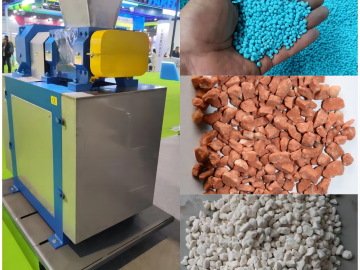
The route decision should precede the equipment configuration. SAFI Machinery offers both blending and granulation systems, including an NPK fertilizer production line using extrusion. This allows the discussion to follow the intended product instead of assuming every first factory needs the same arrangement.
Your intended product
Route worth evaluating
Main condition to establish
A physical mixture of existing granules
Bulk blending
Ingredient compatibility and customer acceptance
New granules from suitable prepared powders
Roller press granulation
Forming performance with the actual formulation
Granules grown using moisture and tumbling
Steam drum granulation
Stable granulation, drying and cooling together
A useful demonstration follows the material
A production demonstration is most helpful when it resembles your proposed operation. Running an easy material proves less than processing a representative formulation. For a roller press granulator production line, examine the screened product as well as the particles leaving the rolls. The two quantities need not be identical.
The demonstration should answer a small number of concrete questions:
*Are the feed materials comparable to those you can buy?
*Does the bagged product match the sample customers accepted?
*How much acceptable product is produced during the observed run?
*What changes when the next planned formula enters the line?
Those answers make capacity discussions more useful. An NPK production line that briefly reaches a target on an unsuitable demonstration material has not established performance for your business. Ask for the operating conditions behind the result, including any screening or reprocessing that sits between forming particles and filling bags.
The first investment needs a clear product boundary
Your first plant should make a defined fertilizer for an identifiable customer group. Blending is a credible starting route when compatible granules and an accepted blend already exist. Granulation deserves the additional processing stages when the required product calls for them. Establish that boundary first, then compare configurations capable of meeting it.
Is bulk blending the same as compound granulation?
No. Blending mixes existing fertilizer particles. Granulation forms new particles from prepared material. Matching nutrient totals do not make the manufacturing routes interchangeable.
Can a blending line make different NPK grades?
Yes, by changing ingredient proportions where suitable materials are available. Each proposed mixture still needs compatibility and product quality checks.
Does every first NPK plant need a dryer?
No. Dry blending does not introduce a wet granulation stage. A suitable roller process may also avoid drying, whereas steam drum processing includes moisture removal.
Is the cheapest line the safest starting choice?
Only if it makes the product customers will accept. A lower purchase price offers little protection when the process cannot use your feedstock or meet the required product form.
What sample should I bring to a factory visit?
Bring representative raw materials and an example of the intended finished fertilizer. Together, they make the route comparison much more specific than a nutrient grade alone.