Home > Blog > Comparison of Urea Crusher and Hammer Crusher
Comparison of Urea Crusher and Hammer Crusher
Date 2026.04.02
Share
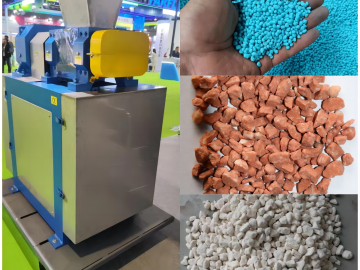
Urea crusher (roller type as an example): The core of the urea crusher is grinding and shearing. It uses two rollers with different rotation speeds (one fast and one slow) to squeeze, grind, and shear the materials. Its advantage is in its extremely low temperature rise, which effectively protects the chemical properties of urea, a heat-sensitive material, preventing melting or agglomeration due to high temperatures.
General hammer crusher: its core is impact and striking. It uses high-speed rotating hammers to strike the material, causing it to break after impacting the liner, and finally being discharged through a screen. Because high-speed impact generates more heat and has a large impact force on the material, it can easily lead to uneven breakage of urea crystals or localized overheating.
Zhengzhou Safi Machinery Co.,Ltd can work out full process solutions and machines for producing water soluble fertilizer, suspension liquid fertilizer, gel liquid fertilizer, organic fertilizer and compound NPK fertilizer.
So, what is the difference on efficiency and superiority between urea crusher and hammer crusher? Mainly as below.
the difference on efficiency and superiority between urea crusher and hammer crusher
Characteristics
Urea crusher(roller type)
General hammer crusher
Anti-sticking and clogging
Significant advantages:it typically has no screen or uses special crushing toothed rollers, specifically designed for the hygroscopic and agglomerated characteristics of urea, making it less prone to clogging.
Prone to clogging. Relies on bottom screen discharge; when the urea has a slightly high moisture content or absorbs moisture, the screen holes are easily clogged, leading to reduced output or even shutdown.
Dust control
Good sealing. Mostly adopt a fully sealed design, and because the grinding action is gentle, less dust is generated, usually requiring no additional auxiliary dust removal equipment.
High dust levels. High-speed impact generates a large amount of fine powder, and the equipment requires high sealing performance; without a dust removal system, the working environment is poor.
Particle size control
Flexible and uniform adjustment. The particle size can be controlled by precisely adjusting the gap between the two rollers, typically the ranging between 30 and 70 mesh. Finally thus can be in uniform finished particle size and minimal over-grinding.
Relies on screen. Particle size is mainly controlled by changing screens with different aperture sizes, the adjustment range is limited, and the screen is prone to wear.
Wear and maintenance
Low maintenance cost. The main working parts (rollers) are highly wear-resistant and are typically made of 304 stainless steel to combat the corrosive nature of urea, resulting in a long service life and no easily damaged parts (such as hammers).
Severe wear. Hammers and screens are easily damaged parts, especially when handling corrosive urea. Hammers wear extremely quickly, requiring frequent replacement and resulting in low metal utilization (approximately 25%).
How to Choose these two different crushers?
We recommend to choose the urea crusher (roller type) on below working conditions:
Working site:compound fertilizer/water-soluble fertilizer/liquid fertilizer production lines, workshops with strict dust control requirements, and processing urea raw materials that easily absorb moisture and clump.
Reasons: stable operation, low temperature rise, almost no clogging, and extremely low maintenance costs.
Consider the hammer mills in the following situations:
Scenes: Small workshops, very limited budgets, very small crushing volume, very dry materials, and low dust control requirements.
Reasons: Equipment purchase costs may be relatively low, but higher subsequent maintenance costs and clogging risks are required.
In summary, for urea crusher, it is recommended to prioritize to use. Although general-used hammer crushers are cheaper, urea’s inherent strong hygroscopicity, heat sensitivity, and corrosiveness cause frequent problems such as clogging, high-temperature melting, and rapid hammer wear when using hammer crushers, resulting in relatively high long-term overall costs.