Home > Blog > Choosing a Granulator for Fiber-Rich Organic Fertilizer
Choosing a Granulator for Fiber-Rich Organic Fertilizer
Date 2026.10.14
Share
Honestly, most bad granulator choices trace back to the feed, not the machine. If you’re running fermented manure with heavy fiber in it, put a tubular granulator or stirring teeth granulatorunit at the top of the list. Sticking is what’s killing your forming? That’s the case for a combined stirring-drum setup. And if your feed works for a pan, throw it into the same trial with the same prepared mix. Same feed, different machine, that’s the only fair comparison.
What the manure needs before granulation
Let me save you some trouble here: raw manure won’t granulate. Period. It has to be fermented first, then crushed, then brought close to the right consistency. So before you go anywhere near a machine quote, sit down and write out what your feed actually looks like at the inlet. Moisture, how much bedding is still in it, what it feels like after the crusher. That one paragraph will do more for the buying decision than any brochure.
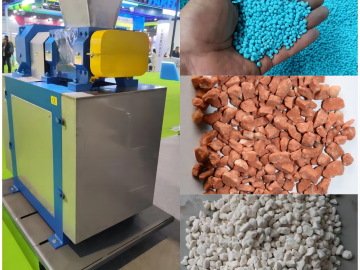
Tubular granulator or stirring teeth granulator is what most people default to when the feed is fermented and fiber-heavy, and honestly it earns that default. Chicken, pig, cow, sheep, all of it runs fine through it. If you’re a farm shopping for equipment, put it in the running, that’s my advice. Where it gets interesting is your own blend. That’s where the real answers come from.
Wheretubular granulator or stirring teeth granulator fits
Once you’ve watched one work, the forming action is easy to explain. The rotor works the powder around inside the casing, friction pulls the fine material into particles, and they get rounder and harder as they travel. If you’re new to this class of machine, learn that part properly. People jump straight to the tonnage specs and miss the one thing that actually tells you whether it’ll work on their feed.
Moisture within a workable range
The moisture number that matters depends on the machine in front of you. With the SAFI Machinery tubular organic fertilizer granulator, you’re looking at roughly 30–40% feed moisture. Feed lands in that range and the preliminary dryer drops out of the flow. Crush, batch, granulate. Done.
Don’t mix that number up with your product spec, it’s for screening only. And mind the two drying jobs, because people do. Drying the feed before granulation and drying the granules after it, those are separate steps, and a downstream dryer sits in your line either way. Dropping the upfront dry saves time and energy, sure, but drying doesn’t disappear from the plant.
Particle size and the yield question
Size is something you set with feed rate and spindle speed. The finished diameter the machine can hit runs 0.3 to 5 mm, which is a wide band. Wider than the product you’ll probably sell, in fact. So pin down the size band you actually need before you start grading samples against anything.
You’ll see an above-85% granulation rate on the spec sheet, and it sounds fine on the surface. The problem is how it got counted. Every particle that formed, or just the ones in the target band, because those give you two very different numbers. Get the feed conditions and operating parameters behind it before you build a saleable output estimate on top of it. Otherwise you’re just guessing with a decimal point.
When a combined stirring-drum system helps
This is the one to reach for the second the feed starts sticking. The combined stirring-drum setup is basically built for exactly that material. Sticky, viscous, moisture-heavy, cokes up as it forms, that’s its whole reason for being. The secondary stirring and the rotating cylinder work directly against adhesion. In a trial, follow the feed through both zones. You’ll know by the end whether you’re still clearing deposits off the walls in normal running.
It works in two stages, back to back. An adjustable feeder fills the first stirring zone, then the material moves on into secondary stirring and the cylinder. If you’re weighing up a compost granulator for sticky manure, the honest test is this: run your own mixture continuously and see if it keeps forming and discharging without clogging.
How the pan granulator changes the comparison
The pan granulator takes a different route. Feed and binder go in, the disc rotates, and particles grow by picking up fines with each pass. It’s got a cleaning mechanism to handle sticking, which helps. Fair to keep it in this comparison, but be clear: not every manure mix behaves in a pan the way it does in a stirred design.
Rotor stirring and friction do the work; particles round out and harden.
Does fibrous feed hold target size across runs?
Combined stirring-drum
Primary stir, then secondary stir plus the cylinder.
Sticky feed: does it clear both zones without buildup?
Pan or disc
Disc tumbling with a binder; particles grow from the fines.
Does your mix granulate to spec without sticking out of hand?
What a useful comparison should show
Run a feed trial. Use the actual fermented mixture you plan to process, and write down every adjustment for each pass. When you pull samples out of the organic manure granulator, don’t stop at judging the particles in your hand. The conditions that made them matter just as much, so keep them with the samples.
Feed moisture and prep, written down before you start.
How much actually lands in the target size band.
Watch the walls, any discharge that stalls, and how the cleaning goes.
After the planned drying and screening, re-check the particle condition.
At the end of it, the trial should hand you a reason to pick. Ask the organic fertilizer machinery supplier to stand behind its recommendation with what your feed actually showed. Both samples look fine on the table? Then compare the runs: which one needed more tweaking, how did each behave when conditions drifted.
The selection comes back to the feed
So where does that leave you? Fibrous fermented manure, start with a tubular trial. Adhesion is your main headache, dig into the combined stirring-drum setup. Tumbling might suit your feed too, in which case keep the pan granulator in the running. Base the final call on particle quality you’ve actually seen and operation you can manage, with every performance number tied to the machine you’re buying. Not a brochure for a different one.
If you’d like a second set of eyes on the options, contact SAFI Machinery. Bring them your feed details and the granule spec you’re after, and talk it through.
FAQ
Can a tubular granulator process manure containing fiber?
Yes. That’s basically what it’s built for, and fiber-heavy fermented feeds sit right in its range. Just keep one thing straight: the material still has to arrive at the machine in prepared condition. The machine won’t skip your prep work for you.
Is a combined stirring-drum machine always the better choice?
Not by default. The secondary stirring and the cylinder really come into their own when adhesion and forming are your actual problems. Run your own mix first, though. If those features don’t move your numbers, don’t let them make the decision for you.
Does a pan granulator work with organic fertilizer?
Yes. Organic fertilizer powders and other fertilizer materials are fair game for pan granulation. Whether your specific manure mix will cooperate, you’ll find out by watching how it behaves during tumbling, binding, and discharge. Watch a trial, it tells you everything.
Does 30–40% moisture apply to every granulator?
No, and this is one that regularly trips people up. The range is specific to the tubular design in this article. A pan or a combined machine has its own sweet spot, and neither one inherits this number. It’s also not the moisture level you ship in the packaged product.
What should an above-85% granulation rate mean to a buyer?
It should make you ask how they counted. For the tubular unit, get the feed conditions, what they counted as a formed granule, and the size range they included. Then separately, work out what share of that meets your own product spec.